


, smart infrastructure, and the digital economy have made cybersecurity both relevant and essential to the countryâs long-term growth, an official of an Indonesia-based tech firm has said.</p><p>âQatar is particularly interesting because of its ambitious vision for technology, innovation, and digital transformation,â Patrick Dannacher, president director and CEO of ITSEC Asia, told Gulf Times in an exclusive interview.</p><p>Dannacher said, âAs the country continues to invest in AI, smart infrastructure, and the digital economy, cybersecurity becomes an essential enabler of trust and resilience.â</p><p>He continued, âWe believe there are tremendous opportunities ahead, and we are committed to supporting organisations across the region with world-class expertise, innovation and a long-term partnership approach.</p><p>âUltimately, our mission is very simple: to help businesses and governments innovate with confidence and provide something increasingly valuable in todayâs digital economy, which is peace of mind.â</p><p>According to Dannacher, the company started in Indonesia 16 years ago with seven people. It has since grown to more than 400 cybersecurity professionals across offices in Southeast Asia, Australia, and the Middle East. It is the only listed cybersecurity company on the Indonesian Stock Exchange, he noted.</p><p>Dannacher said ITSEC Asiaâs entry into the Gulf came through a Dubai base, established in 2017, from which it serves organisations across the GCC with services spanning advisory, managed security, penetration testing, security assessments, and cyber resilience programmes.</p><p>He said the Middle East was a logical next step because it resembles what his teams saw in Southeast Asia years earlier.</p><p>Dannacher said the Middle East and Southeast Asian regions are undergoing rapid digital transformation, embracing AI at scale and generating rising demand for cyber resilience. In both markets, organisations are searching for partners who can help them grow without making themselves more vulnerable in the process, he also said.</p><p>What those organisations are navigating has changed sharply in recent years, Dannacher pointed out, adding that âthe threat landscape has changed dramatically in recent years. Attacks are becoming more targeted, more persistent and increasingly AI-enabled.â</p><p>He said, âWhat is different today is that many attacks are no longer being driven only by humans.â</p><p>Dannacher cautioned that AI is helping attackers automate reconnaissance, develop phishing campaigns, generate deepfakes, and identify vulnerabilities much faster than before.</p><p>âA human needs a little bit of sleep. AI does not. As long as it has enough computing power, it can keep working around the clock,â he said.</p><p>The tools fuelling these threats have also become cheaper and more accessible, Dannacher warned. âAI is lowering the barriers to entry for cybercriminals. Many of the tools available today are inexpensive or freely accessible, which means attackers no longer need the same level of expertise or resources as they once did,â he stressed.</p><p>Cybersecurity is not only a technology challenge, he explained, adding that stopping at technology is a mistake.</p><p>âIt is also about people, training, and visibility. Organisations need to understand where they are vulnerable, continuously monitor their environment, and make cybersecurity part of everyday business operations,â Dannacher added.</p><p> </p>__%20%20%20%20<p>Related%20Story</p>_%20%20%20%20_%20%20%20%20%20%20%20%20%20%20%20%20%20%20%20%20_%20%20%20%20%20%20%20%20%20%20%20_%20%20%20%20%20%20%20%20%20%20%20%20_%20%20%20%20%20%20%20%20%20%20%20%20%20%20%20%20%20%20%20%20%20%20%20%20%20%20%20%20%20%20%20%20%20%20%20%20%20%20%20%20%20%20%20%20%20%20%20%20%20%20%20%20%20%20%20%20%20%20%20%20_%20%20%20%20%20%20%20%20%20%20%20%20%20%20%20%20%20%20%20%20%20%20%20%20__%20%20%20%20%20%20%20%20%20%20%20%20%20%20%20%20%20%20%20%20%20%20%20%20<img%20loading=?resize=150,150&ssl=1 "Knowledgeable: Cybersecurity key for Qatarâs virtual enlargement")


Whilst you consider a big asteroid have an effect on, it’s possible you’ll believe a second of devastation: a violent collision, a blast of warmth and particles, after which years of atmospheric disruption and injury left in the back of.
However at the early Earth, an important impact would possibly not had been the crater and its aftermath. It’ll had been the warmth from the have an effect on, pushed deep into our planet’s internal.
In our new find out about, we argue the long-lived impact of this have an effect on heating has been a great deal underappreciated in fashions of the Hadean eon – the primary half-billion years of Earth’s historical past.
Relatively than appearing as temporary interruptions to a planet cooling from inside of, repeated affects stored the outside, or protocrust, of the younger Earth sizzling, susceptible and geologically risky for a long time.


That issues for the reason that Hadean is among the greatest puzzles in Earth science. Tiny zircon crystals display that portions of Earth’s floor have survived for greater than 4.3 billion years, and that water was once provide very early. However virtually no intact rocks live on from this time. The oldest recognized continental rocks are about 4.03 billion years outdated.
So what came about all through the lacking period?
Related News


A deeper have a look at affects
There’s a temptation to think about giant asteroid affects as short-lived floor occasions. But the Moon preserves a stark document of ways not unusual such collisions had been within the early Sun Machine.
Those house rocks would have battered Earth much more intensely than they did the Moon, and the affects carried monumental quantities of power that was once transferred deep into the planet itself.
In our modelling, we display the have an effect on warmth was once now not simply a minor addition to Earth’s interior power price range. Via lots of the Hadean, have an effect on heating seems to have hugely outweighed warmth produced inside of Earth itself.
Related News


Simply as importantly, the impact was once now not restricted to warming the rocks on the floor. By way of including warmth and thinning or obliterating the crust, massive affects would have led to melting of the mantle underneath the have an effect on website online, producing massive volumes of basaltic magma.
Warmth transferred into the mantle from the largest affects most likely influenced volcanism and tectonic behaviour for tens to loads of tens of millions of years.
The Moon’s cratered floor preserves a document of the numerous asteroid affects all through the Sun Machine’s early days.
NASA/Artemis II workforce
An overly other early Earth
This discovering has giant penalties for a way we image the Hadean.
Some researchers have argued the early Earth could have been extra very similar to the fashionable Earth than we as soon as concept, possibly even able to plate tectonics in a kind now not solely not like nowadays’s.
Our effects level in a distinct course.
If affects had been including this a lot warmth to the machine, the early crust was once most likely skinny, susceptible and in part molten underneath shallow depths. That doesn’t glance similar to the fashionable Earth. It seems to be extra like a planet whose outer shell was once being again and again renewed.
How continents may just emerge from a sizzling starting
Massive affects would have fractured the younger crust and helped water flow into via it for lengthy sessions, changing rocks close to the outside. On the identical time, melting of mantle underneath have an effect on websites would have provided massive volumes of magma to and in the course of the crust.
As those processes repeated, the outside ended up being composed of extra silica, which is what we see within the pale-coloured rocks that characterise continental crust.
That may additionally lend a hand give an explanation for why the Hadean rock document is so sparse. If the crust was once again and again heated, melted and recycled, a lot of Earth’s earliest crust might merely now not have survived.
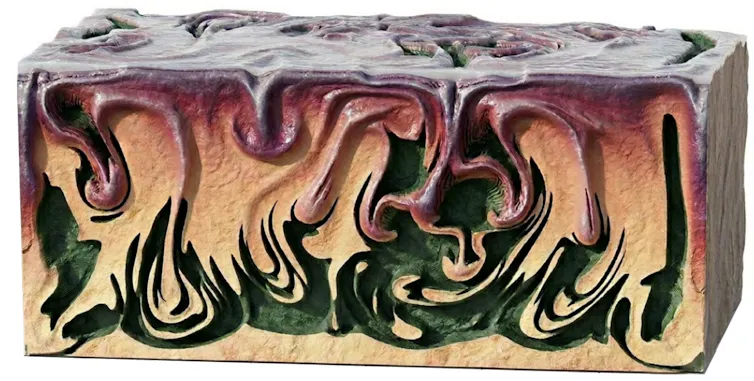
An indication of vigorously convecting mantle after a big have an effect on. The skinny gray floor layer is the protocrust. The field proven is 1,200km broad via 600km deep.
Tim Johnson
What modified 3.9 billion years in the past
It’s obvious from research that experience analysed the have an effect on historical past of the Moon that, via round 3.9 billion years in the past, the worldwide impact of have an effect on heating within the inside Sun Machine had grow to be a lot much less essential. That also is across the time Earth started to maintain massive tracts of continental crust.
That timing turns out not likely to be a twist of fate.
As soon as the bombardment eased, the crust would have had an opportunity to chill, solidify and thicken. Best then might long-lived continents have grow to be conceivable.
All this implies repeated affects could have restricted when Earth may just start to maintain a extra lasting crustal document.
Our find out about does now not finish the talk concerning the Hadean. However it does recommend that any sensible image of the early Earth has to take affects, and have an effect on heating, severely.
If this is proper, then the younger Earth was once now not simply scarred via affects. It was once reshaped via them, and the primary continents might best have persisted as soon as the violence started to vanish.


