


.</p><p>Adaya, who has lived in Qatar for more than 15 years, discovered the potential of soilless cultivation while looking for meaningful ways to spend time with his family during the global health crisis. The success of producing fresh food at home prompted him to share his experience through social media and small community workshops, he said.</p><p>“We started growing vegetables through hydroponics at home, and I was amazed that we could produce fresh, healthy food without soil. As I shared our journey on social media and through small community workshops, I realised many people in Qatar were eager to learn about modern farming but didn’t know where to begin,” he explained.</p><p>This localised interest led to the launch of the ‘Future of Agriculture – Hydroponics’ advocacy, noted Adaya, adding that the initiative aims to make modern farming practices accessible to families, schools, and local entrepreneurs.</p><p>The transition from financial services to agricultural technology proved natural for Adaya, who explained that his finance background provided critical perspective in data analysis, risk management, and the formulation of sustainable business models.</p><p>“People often think finance and agriculture are completely different fields, but I see many similarities. My background in finance taught me how to analyse data, manage risks, create sustainable business models, and make informed long-term decisions,” he pointed out.</p><p>Adaya said, “Agriculture today is no longer just about planting crops. It involves technology, resource management, innovation, and sustainability. Financial discipline helped me understand how to build solutions that are both environmentally sustainable and economically viable”.</p><p>Operating within Qatar requires navigating specific environmental constraints, he pointed out.</p><p>“Qatar’s climate presents unique challenges. The extreme summer temperatures, limited freshwater resources, and high cooling requirements make farming difficult. In the beginning, we experienced crop failures, equipment issues, and many trial-and-error experiments. Instead of seeing those as failures, we treated every challenge as valuable research,” he said.</p><p>Adaya continued, “Those experiences convinced me that Qatar doesn’t need to copy farming methods from other countries. We need technologies specifically designed for desert environments. That belief continues to drive our research and development today.”</p><p>According to Adaya, the establishment of Hydrovest Technology was intended to address an identified gap in the domestic market. While large-scale public investments have enhanced national food security, affordable technology and technical guidance remained scarce for smaller, community growers.</p><p>“I noticed that while Qatar has made remarkable investments in food security, there was still a need to make advanced farming technologies more accessible to the wider community.</p><p>“Many people were interested in hydroponics but lacked practical knowledge, affordable solutions, and technical guidance. Hydrovest Technology was created to bridge that gap by combining education, research, and innovation,” he stressed.</p><p>The company focuses on a broader definition of commercial success, said Adaya, who also emphasised that leadership in sustainability must balance financial metrics with societal value, focusing on inspiring local communities to adopt independent food production.</p><p>“Success should not be measured only by financial performance but also by the positive impact we create for society. If our work inspires one child to love agriculture or helps one family grow their own food, then we are already making a meaningful difference,” Adaya added.</p><p> </p>__%20%20%20%20<p>Related%20Story</p>_%20%20%20%20_%20%20%20%20%20%20%20%20%20%20%20%20%20%20%20%20_%20%20%20%20%20%20%20%20%20%20%20_%20%20%20%20%20%20%20%20%20%20%20%20_%20%20%20%20%20%20%20%20%20%20%20%20%20%20%20%20%20%20%20%20%20%20%20%20%20%20%20%20%20%20%20%20%20%20%20%20%20%20%20%20%20%20%20%20%20%20%20%20%20%20%20%20%20%20%20%20%20%20%20%20_%20%20%20%20%20%20%20%20%20%20%20%20%20%20%20%20%20%20%20%20%20%20%20%20__%20%20%20%20%20%20%20%20%20%20%20%20%20%20%20%20%20%20%20%20%20%20%20%20<img%20loading=?resize=150,150&ssl=1 "Doha Information startup grows hydroponics for a warmer, drier long run")


More or less 50,000 years in the past, a kangaroo in contrast to any alive lately lived within the mountain rainforests of New Guinea.
First found out through Western science in 1983, Protemnodon tumbuna was once kind of the dimensions of a contemporary purple kangaroo however a lot more stocky and muscular. Maximum peculiarly, it hopped little, if in any respect. It moved most commonly on all fours, with lengthy, robust forelimbs offering beef up for agile bounding via advanced and steep terrain.
This ordinary animal was once one of the megafauna that when roamed Australia and New Guinea. It’s concept to have long gone extinct some 20,000 to 50,000 years in the past.
Then again, our new learn about, revealed within the magazine npj Biodiversity, suggests Protemnodon tumbuna survived till as overdue as 6,000 years in the past in northern New Guinea.
Related News


This constitutes forged proof the Australian and New Guinean megafauna didn’t all cross extinct on the identical time, however that some held on for for much longer than others. It additionally contributes to a extra advanced symbol than standard arguments about what drove the extinction of megafauna.
Clues from Papua New Guinea


All seven Protemnodon species had long gone extinct in Australia through 41,000 years in the past, together with just about all different megafauna species. Whether or not the general extinctions on this procedure have been pushed basically through local weather exchange or human overhunting stays closely debated.
However in New Guinea, the proof is mounting against a quite other tale.
On the Nombe rockshelter, within the highlands of japanese Papua New Guinea, fossils of Protemnodon tumbuna display it lived in the neighborhood till 22,000 to 27,000 years in the past, throughout the ultimate ice age.
Extra proof of late-surviving Protemnodon tumbuna in New Guinea got here in 2024 with the invention of a unmarried teeth from Lachitu cave, positioned within the foothills of the Oenake Vary, at the northwest coast of Papua New Guinea.
Related News


The teeth had come from a limestone deposit dated 18,000 years outdated or more youthful, even though it’s unclear whether or not the teeth itself was once additionally that contemporary.
In 2004, archaeological excavations at Taora – a rockshelter simply west of Lachitu – produced a big choice of well-preserved animal stays.
After most sea ranges receded 6,800 years in the past, Taora was once used intensely through other folks exploiting within sight marine and rainforest sources. Over the following 1,500 years, they all of a sudden constructed up a dense deposit of discarded bones and shells, and masses of small bone issues that most likely tipped fishing spears or arrows.
Archaeological excavation at Taora rockshelter in 2004 which discovered the megafauna fossil.
Anthony Barham
Our discovery
Whilst analyzing this wealthy assortment to know how historic other folks had lived within the dense coastal rainforest, one bone stood out to us.
It was once from the finger of a macropodid – a member of the kangaroo circle of relatives – however one a lot greater than any species of marsupial present in New Guinea lately.
Suspecting it represented an unrecorded species, we when put next the specimen’s form and measurement to as many extant and extinct macropodids as conceivable to decide which one it most likely belonged to.
The Taora fossil is obviously other to all lately residing macropodids. It’s maximum very similar to individuals of Protemnodon – particularly, the New Guinean species Protemnondon otibandus.
This species is considered the traditional ancestor of Protemnodon tumbuna, for which no fossils of the finger bones are recognized.
The fossil has some distinctive characteristics that distinguish it from different Protemnodon species, together with very outstanding projections above the realm the place this center finger bone joins to the claw.
However at the complete, it intently resembles many species within the genus. And because we all know Protemnodon tumbuna was once provide within the native space (a couple of kilometres away), possibly as not too long ago as 18,000 years in the past, the fossil from Taora in all probability belongs to it.
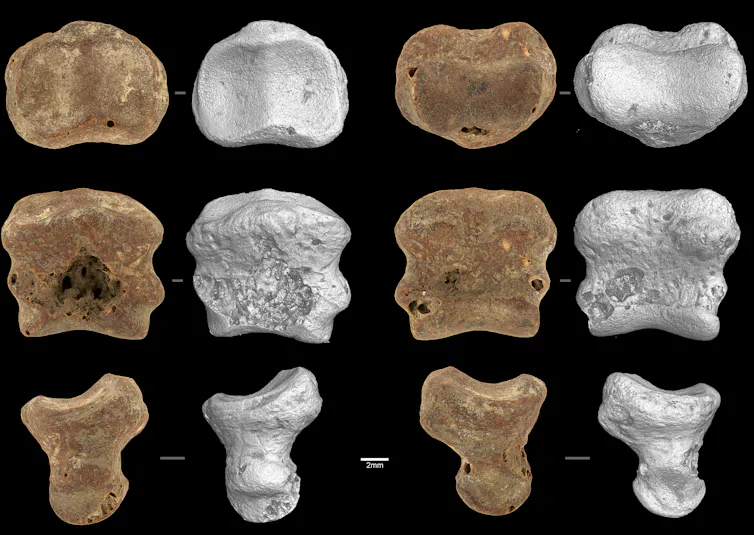
The large kangaroo fossil from Taora, a finger bone which most likely belongs to Protemnodon tumbuna.
Loukas Koungoulos
A tale of prolonged survival
Learn along side the present proof from Nombe and Lachitu, the Taora fossil presentations other folks will have to have co-existed with some species of megafauna for tens of hundreds of years. They’d have performed so whilst additionally growing agriculture and village-dwelling societies in New Guinea.
That’s a some distance cry from the “overkill” style, which implies the earliest First Countries other folks of Australia and New Guinea all of a sudden hunted all last megafauna to extinction.
This doesn’t imply other folks couldn’t have contributed by hook or by crook to the extinctions. However it does level to a fancy state of affairs and the important thing position of every species’ distinctive biology and ecology in how they fared towards human looking and finer-scale habitat exchange.
At the north coast of New Guinea, each elements have been most likely at play.
Research of Protemnodon enamel from Mount Etna in central japanese Queensland have discovered those kangaroos had small house levels. They didn’t transfer some distance with the intention to forage or migrate, an inclination that would go away them extraordinarily susceptible to habitat loss.
Drying climates during the last few hundred thousand years ceaselessly shrank their highland rainforest habitat in New Guinea – and stimulated the fast expansion of within sight human populations. Sooner or later, the habitat turned into so small it couldn’t beef up a viable inhabitants of those historic kangaroos.
Trapped and not able to achieve their more and more far-off house, the ultimate massive kangaroos of New Guinea’s north coast would have temporarily succumbed to even gentle looking force, becoming a member of different uncommon marsupials that disappeared from this area on the identical time within the face of post-glacial environmental adjustments.
As we proceed to discover the fossil secrets and techniques of this far flung segment of New Guinea, there might but be extra twists within the tale of Australia and New Guinea’s shared palaeohistory.


