


Qatar Airways is famous for its QSuite business class, which is still regarded as being one of the top three business class seats in the world, if not number one. But it’s been over nine years since the product hit the market, and with subsequent seats from top airlines matching or surpassing QSuite, it’s time for an update. In 2024, Qatar Airways revealed QSuite Next Gen, which is rumored to debut on the Airbus A350-1000 later in 2026 and is confirmed to be coming to the Boeing 777-9 in 2027.
Qatar Airways has long partnered with B/E Aerospace for its business class seats since the 2000s with the supplier’s MiniPods seats, while later installing the Diamond on some of its A320s/all A330s and Super Diamond seats on the early A350-900s/all A380s/all 787-8s. QSuites was a custom design, but still built by Collins Aerospace (which acquired B/E Aerospace in 2017). With QSuite Next Gen, however, Qatar Airways has moved away from Collins Aerospace and is instead working with Elevate Aircraft Seating (formerly Adient Aerospace).
What To Expect From The QSuite Next Gen
Credit: Qatar Airways
Related News



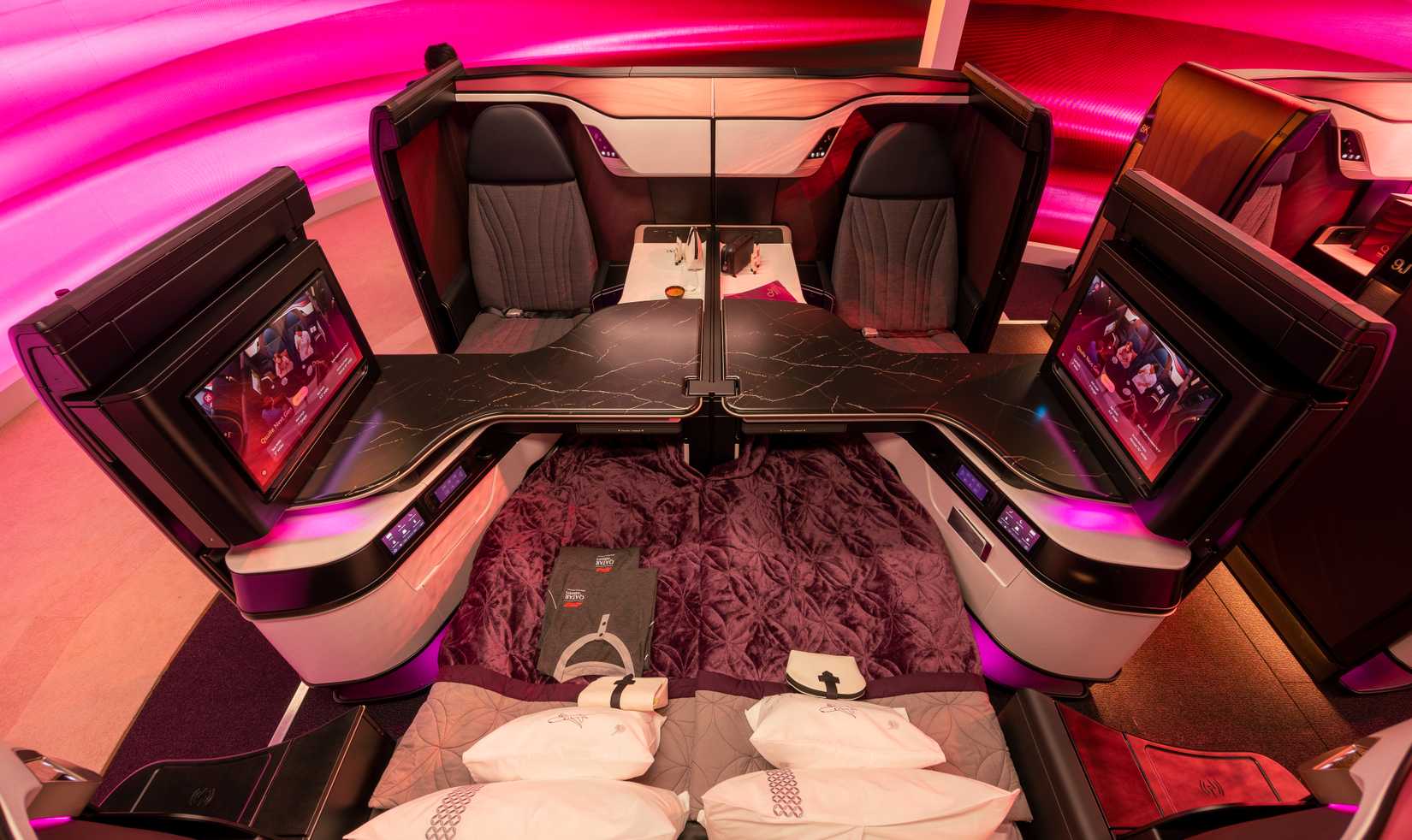
QSuite Next Gen is the new flagship business class seat that will debut either in 2026 or 2027. It will be featured on all Boeing 777-9s, as has currently been reported, and will also be installed on future Airbus A350-1000 deliveries. It’s unclear when exactly the carrier will begin installing QSuite Next Gen on the A350-1000, of which the airline has 13 still on order. The customer seats were designed by Acumen in partnership with Qatar Airways and will be manufactured by Elevate Aircraft Seating.
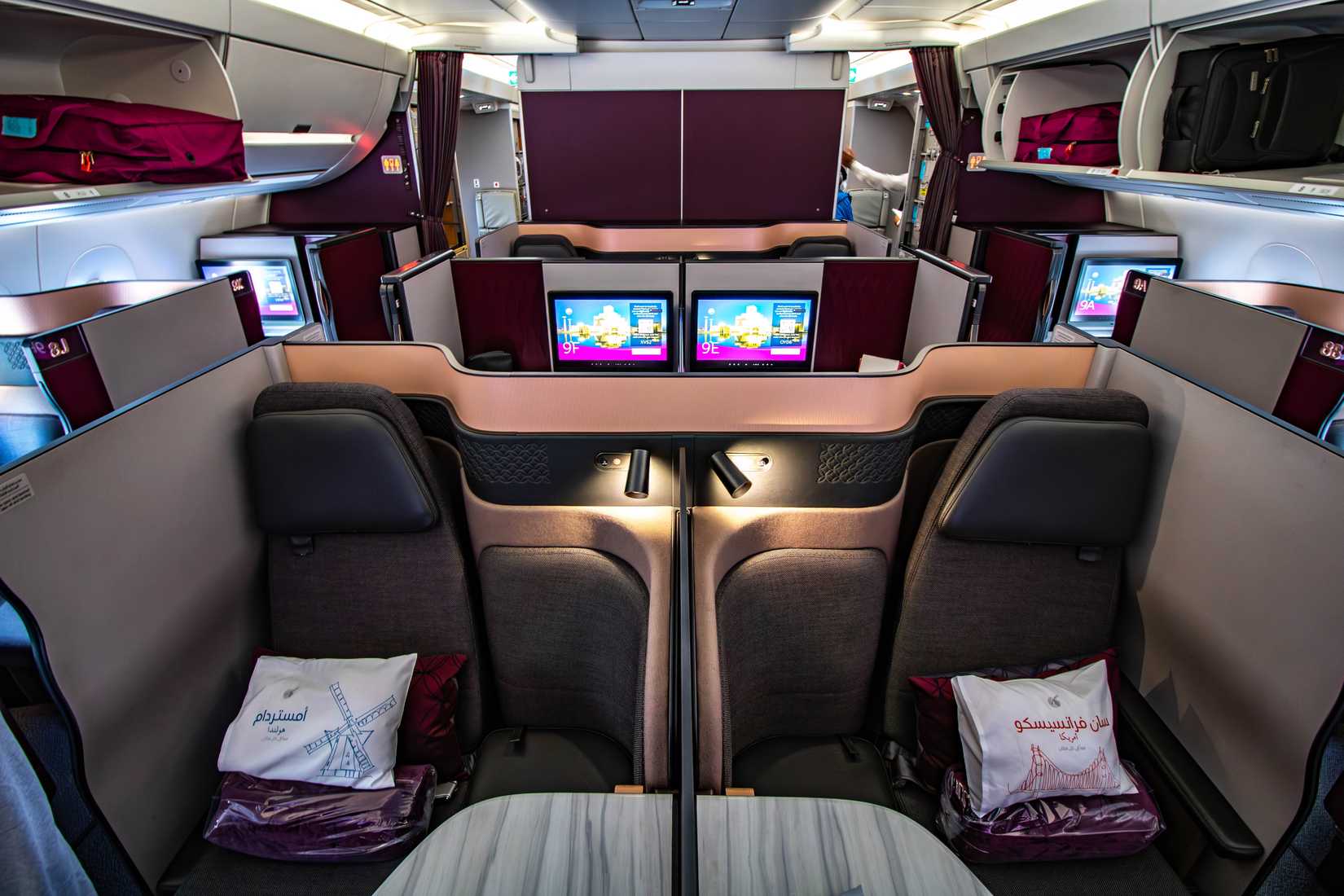
Visually, the seats strongly resemble the prior QSuite, which is essentially a staggered lie-flat product that alternates between forward and rear-facing while featuring a sliding door. What elevates QSuites from most subsequent lie-flat seats is the customization, as the central divider between honeymoon suites can lower to create a double bed. In addition, the lateral dividers in the center suites can partially retract to create ‘quad suites’, while the suites in general feature larger screens, high suite walls, quality finishes, and are spacious.


With QSuite Next Gen, the lateral dividers can fully retract with the screen, and this same feature is offered in the window seats to create ‘Companion Suites’. The technology has been improved, while the seat and bed have been slightly enlarged. The privacy dividers are higher, and the doors will be electronically controlled, while the suites will incorporate additional storage. It doesn’t move the game forward like the original QSuites, but it will represent a nice upgrade for passengers.
Qatar Airways’ Relationship With Elevate
Credit: Qatar Airways
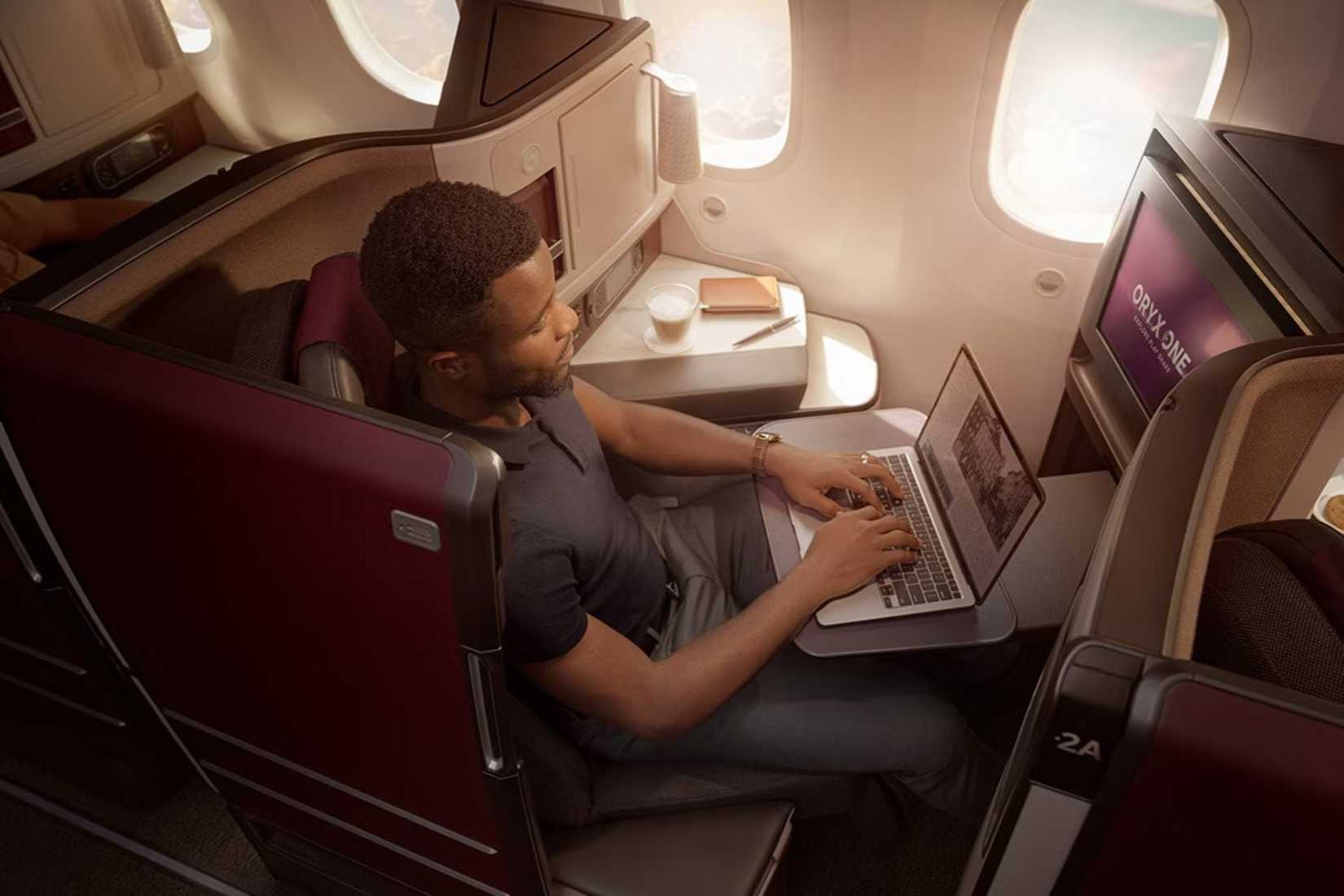
Qatar Airways currently has several business class products in its fleet, but many of these are present on used aircraft that the airline acquired/leased post-pandemic and that retain their original interiors. On the aircraft that Qatar ordered itself, the airline has primarily purchased from B/E Aerospace/Collins Aerospace for its business class seats, while also installing Recaro recliner seats for business class on most of its A320 fleet. With the Boeing 787-9 in 2021, however, Qatar Airways went with Elevate.

Elevate Aircraft Seating is a joint venture between Boeing and Adient plc, and the Ascent seat selected by Qatar Airways is a reverse herringbone seat with sliding doors designed specifically for the 787. It’s space-efficient while being highly customizable (Qatar Airways configures the center suites in a herringbone layout), and Qatar was only the second airline to select the Ascent, which has become increasingly popular with 787 operators.
Elevate Ascent Customers
Air Canada (Boeing 787-10 Dreamliner)
EVA Air (Boeing 777-300ER)
Air India (Boeing 787-8 Dreamliner)
Qatar Airways (Boeing 787-9 Dreamliner)
Alaska Airlines (Boeing 787-9 Dreamliner)
United Airlines (Boeing 787-9 Dreamliner)
American Airlines (Boeing 777-300ER, 787-9 Dreamliner)
Qatar already has a relationship with Elevate, and in all likelihood, the supplier was able to offer a lower price with better terms than Collins Aerospace. Elevate is a relatively new manufacturer that’s much smaller than Collins, and it would therefore be more willing to win business with a major airline like Qatar Airways through aggressive pricing. Qatar still maintains a relationship with Collins and has selected the supplier’s Ascentia analytics solution to manage maintenance for its 787 fleet, but with the QSuite bid, Elevate won the battle.
Supply Chain Challenges In The Industry
Credit: Shutterstock
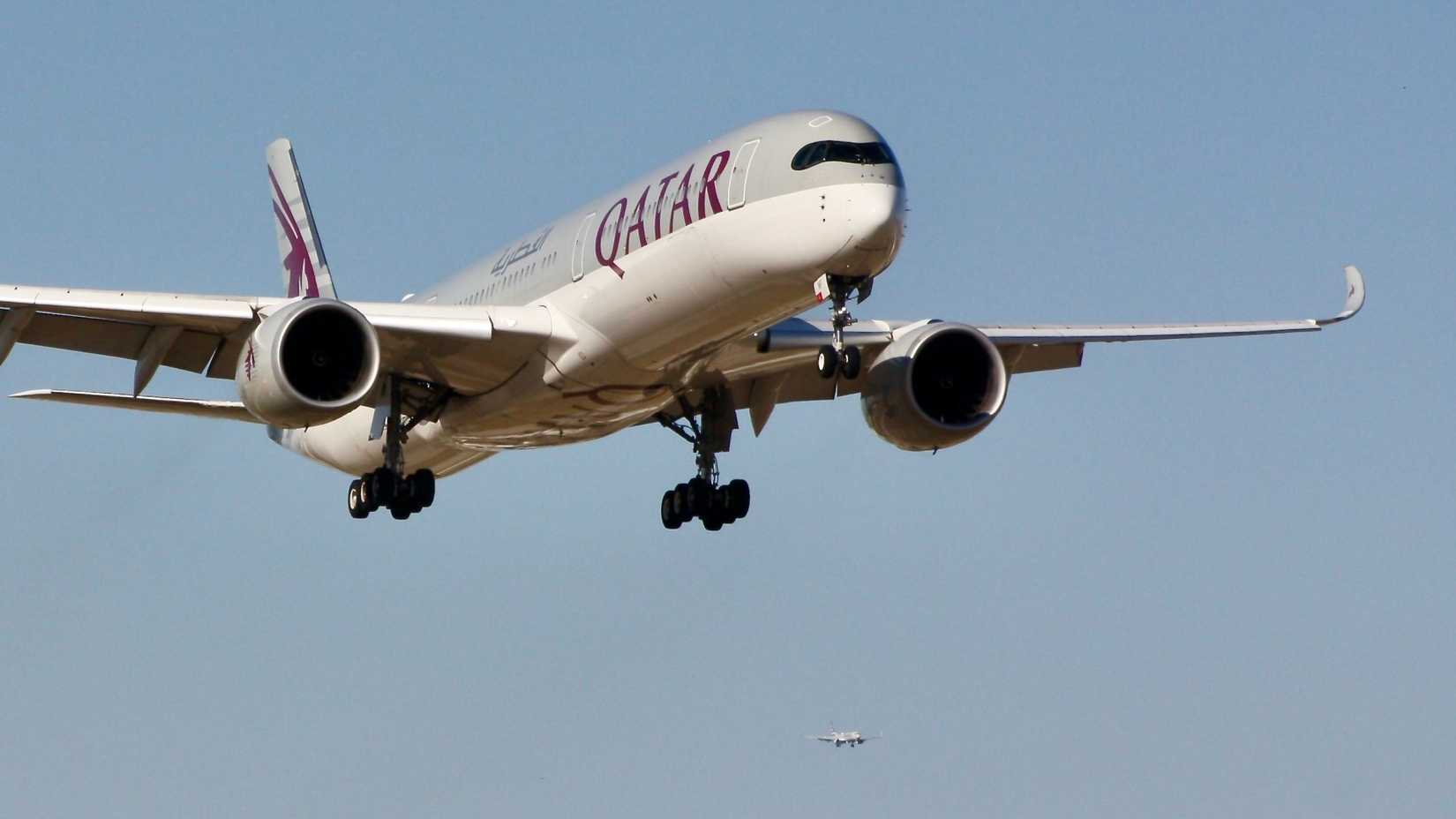
The new topic in the airline industry post-pandemic is supply chain constraints. A wave of retirements of skilled workers, a general shortage in raw materials, and a rapid rise in demand for components have led to massive backlogs as well as delays. Collins Aerospace, along with all other suppliers, has been significantly impacted by supply chain constraints, and new seats continue to be delayed. What’s more, increasing regulatory scrutiny has led to certification delays as new seats become more complex.
As previously discussed, Elevate is a much smaller manufacturer than Collins Aerospace, and while it’s also been affected by supply chain issues, the strategy is to reduce risk. Qatar is a much bigger customer within Elevate’s portfolio compared to that of Collins, which means that the supplier can focus and prioritize QSuite Next Gen to a greater degree than Collins. This is especially true considering that QSuite Next Gen is a custom product which introduces another level of complexity.
The tradeoff is that, as a newer manufacturer, Elevate is less experienced in the industry. QSuite Next Gen is the company’s first-ever custom seat model, and it’s only the third ever seat that Elevate has produced (following the Ascent and the Altitude narrowbody seat selected by United Airlines). QSuite Next Gen is also Elevate’s first product that will be certified on an Airbus widebody, as the Ascent has so far only been selected for the Boeing 777 and 787, while the Altitude is only being installed by United on the Airbus A321neo/A321XLR.
Delivery Timelines For Qatar Airways
Credit: Qatar Airways
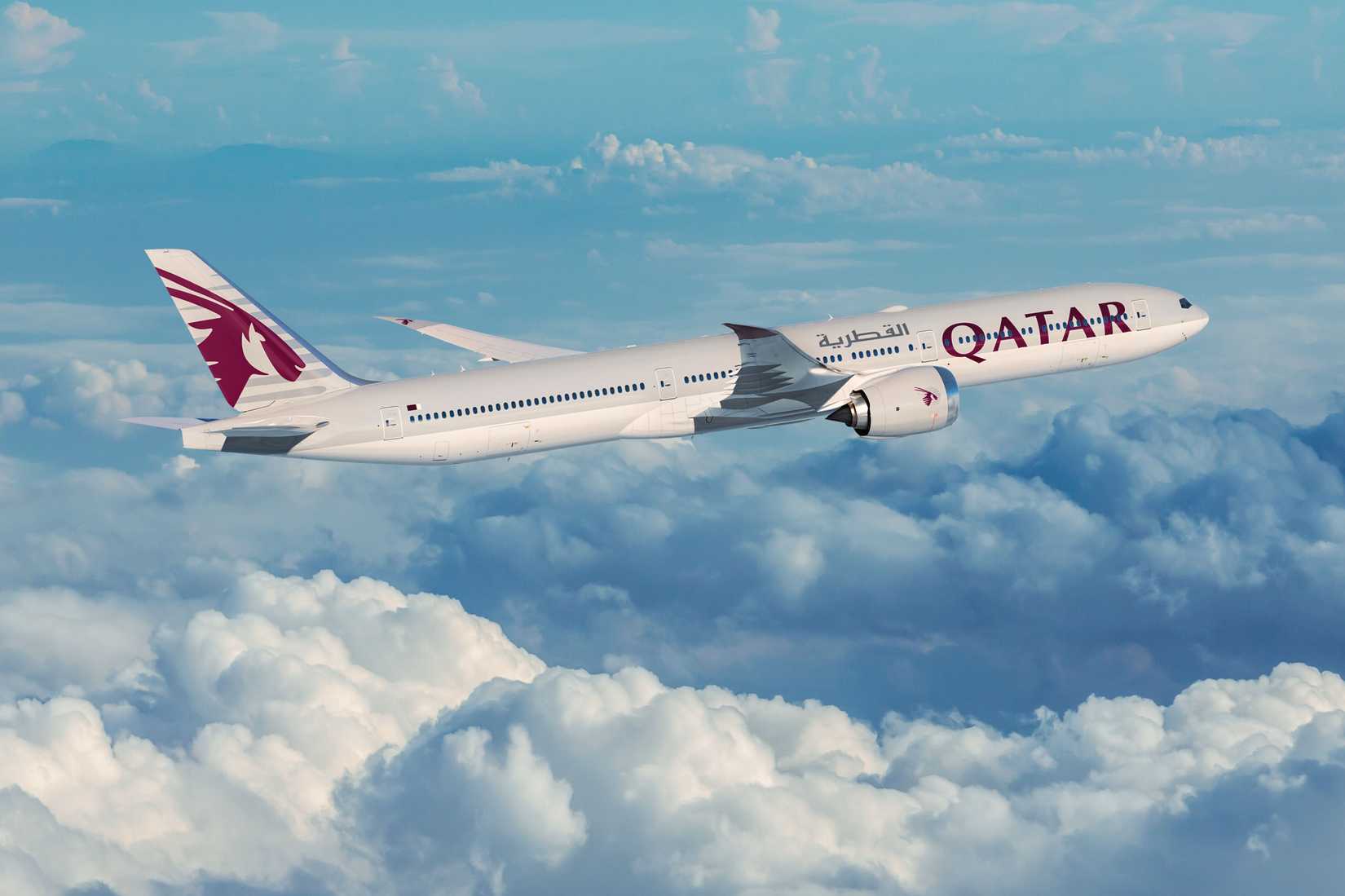
When Qatar Airways revealed QSuite Next Gen in 2024, the carrier was planning to debut the product on the Boeing 777-9 in either 2025 or 2026, depending on the aircraft’s delivery. For a product as complex and customized as QSuite Next Gen, it may have been difficult for Collins Aerospace to accommodate Qatar Airways on its desired timeline. Elevate Aircraft Seating, with a smaller list of customers and a greater need to grow, may have been able to slot Qatar in more easily.
The 777-9 has now been delayed until early 2027, which has delayed the launch of QSuite Next Gen, and it’s now believed that the product will debut on the A350-1000 instead. While Elevate’s ability to deliver the seat may have played a major role in Qatar’s decision, the delay could be a blessing in disguise for the supplier. This has allowed extra time for Elevate to rectify any teething issues that could come up with the seat, while also allowing more time to prepare for certification.
In addition, the reported decision to introduce the seat on the A350-1000 is also a hidden benefit for Elevate. Debuting a brand-new seat on a brand-new aircraft introduces another layer of complexity. The Airbus A350, on the other hand, is a proven aircraft type that could be an easier platform to certify a new seat. Certification is especially important today as several manufacturers have experienced difficulties due to increased regulatory oversight coming into conflict with increasingly complex models. This causes delays and costly redesigns in some cases.
Related
Sky-High Luxury: Comparing Qatar Airways & Emirates’ Premium Suites
Discover how Qatar Airways and Emirates premium suites stack up in the sky-high world of luxury travel: suite doors, double-beds, showers, and more!
Qatar Airways’ Business Class Situation Going Forward
Credit: Shutterstock
QSuite Next Gen will be installed on future A350-1000 deliveries (of which 13 are on order, though it’s unclear which delivery will debut the product), along with Qatar’s 90 777-9s on order. With this, the carrier will operate around 100 aircraft with QSuite Next Gen. Notably, however, the airline will not retrofit any aircraft with the new seats, meaning that Qatar is adding yet another business class seat to its product lineup, which currently consists of eight different seat models.
Admittedly, the 777-9 will likely replace some legacy aircraft types, including some of Qatar’s used/leased aircraft. As it stands, there are six types of business class seats that were installed by the carrier, along with two seat models present on used/leased aircraft. Presumably, the latter category of planes will be phased out, and Qatar will eventually phase out its A330 fleet, as well as its A320-200 fleet (which will be replaced by A321neos that will feature a new seat model).
Seat Model
Number Of Aircraft (242 Aircraft)
Aircraft Types
QSuite
89 (37%)
Airbus A350-900
Airbus A350-1000
Boeing 777-200LR
Boeing 777-300ER
Elevate Ascent
28 (11%)
Boeing 787-9
Collins Aerospace Super Diamond
65 (27%)
Airbus A350-900
Airbus A380-800
Boeing 777-300ER (former Virgin Australia)
Boeing 787-8
Collins Aerospace Diamond
19 (8%)
Airbus A320-200
Airbus A330-200
Airbus A330-300
Collins Aerospace Minipods
9 (4%)
Boeing 777-200LR
Boeing 777-300ER
Recaro CL4400
17 (7%)
Airbus A320-200
Collins Aerospace Apex Suites
9 (4%)
Airbus A330-200 (former Oman Air)
Airbus A330-300 (former Oman Air)
Boeing 787-8 (former Oman Air)
Safran Cirrus II
6 (2%)
Boeing 777-300ER (former Cathay Pacific)
As a whole, Qatar’s business class offering will remain inconsistent across its fleet. However, this isn’t a major issue for Qatar Airways, because the carrier still has one of the world’s best seats while also introducing an even better model soon. What’s more, QSuite-equipped aircraft make up a plurality of the airline’s fleet, meaning that a significant number of business class passengers do experience the flagship product, and the same will be true for QSuite Next Gen.


