


Officials discussed simpler customs procedures, stronger logistics services and higher bilateral trade flows
Saudi Arabia and Qatar are seeking to make cross-border commerce more efficient by simplifying customs procedures, improving logistics services and addressing measures that could support further growth in bilateral trade.
Officials from the two countries held a virtual meeting to discuss opportunities for strengthening cooperation across trade and logistics. The talks were co-chaired by Qatar’s Minister of State for Foreign Trade Affairs Dr. Ahmed bin Mohammed Al Sayed and Saudi Arabia’s Vice Minister of Transport and Logistics Services Dr. Rumaih Al Rumaih.
The meeting brought together senior representatives from the authorities responsible for foreign trade, customs, transport and logistics in both countries, reflecting the range of government agencies involved in facilitating the movement of goods between the two markets.
![1 Day Only: Qatar Airways To Operate Its 1st Airbus A380 Flight To This City [Map]](https://i2.wp.com/static0.simpleflyingimages.com/wordpress/wp-content/uploads/2024/06/qatar-airways-icon.png?fit=contain&h=22&w=150&resize=150,150&ssl=1 "1 Day Only: Qatar Airways To Operate Its 1st Airbus A380 Flight To This City [Map]")

Qatar was represented by General Authority of Customs Chairman Ahmed Al Jamal and Ministry of Transport Undersecretary Mohammed bin Abdullah Al Maadeed.
Saudi Arabia’s delegation included General Authority for Foreign Trade Governor Mohammed Al Abduljabbar and Deputy Minister for Logistics Services Musa Al Barqi.


Trade flow focus
The discussions focused on improving the flow of trade, simplifying customs procedures and increasing the efficiency of logistics services. Officials also examined ways to raise the overall volume of commercial exchange between Qatar and Saudi Arabia.
The two sides said the proposed measures reflected the close relationship between their countries and would support their shared economic objectives.
The talks placed customs coordination and logistics performance at the center of efforts to expand bilateral commerce. Bringing trade, border and transport officials together allows the two sides to consider the different stages affecting shipments, from customs processing and regulatory procedures to inland transportation and logistics services.


The meeting also followed several earlier discussions in which Qatari and Saudi officials examined transportation links, import and export procedures, supply-chain integration and obstacles affecting commercial activity.
These initiatives align with the countries’ wider efforts to diversify their economies, improve regional connectivity and strengthen the private sector’s role under Qatar National Vision 2030 and Saudi Vision 2030.
Trade growth builds
Bilateral commerce had already recorded significant growth before the latest talks. Qatar Chamber reported that trade between Qatar and Saudi Arabia increased 65 percent in 2024, reaching QAR4.9 billion compared with QAR2.97 billion in 2023.
The chamber said closer cooperation between the two countries’ business communities could create additional opportunities for partnerships, joint ventures and investments in sectors capable of generating sustainable economic value.
During the meeting with an Al-Ahsa Chamber delegation, Qatar Chamber encouraged investors and companies from both markets to examine opportunities and develop trade alliances. The discussions also highlighted the role of the Qatari-Saudi Joint Business Council in connecting businesses and supporting commercial cooperation.
A separate Qatar-Saudi Joint Business Council meeting in October 2025 examined ways to facilitate trade procedures, simplify business establishment and increase mutual investment.
Qatar Chamber said Qatari direct investment in Saudi Arabia had risen from QR9.9 billion in 2021 to QR11.5 billion in 2024. Opportunities were identified in transportation, logistics, supply chains, energy, industry, real estate, contracting, digital transformation, renewable energy and entrepreneurship.
Supply chains advance
The latest talks also build on work conducted through the Qatari-Saudi Coordination Council.
In March 2026, the working group of the council’s Economy, Trade and Industry Committee held its third meeting to review progress achieved during 2025 and discuss its objectives for 2026. The committee examined mechanisms for facilitating imports and exports and strengthening integration between the countries’ supply chains.
Officials also reviewed existing initiatives, obstacles affecting cooperation and possible measures for addressing outstanding challenges. The meeting considered the implementation of directives issued during the eighth Qatari-Saudi Coordination Council meeting at the leadership level.
The committee’s discussions covered economic, commercial and industrial integration, while the July meeting placed additional emphasis on customs procedures and the operational efficiency of logistics services.
Together, the meetings indicate a continuing effort to move from broad cooperation objectives toward practical measures affecting businesses, exporters, transport operators and logistics providers.
In April 2026, the Qatari and Saudi transport ministers also discussed cooperation across transportation and supporting logistics services. Their talks included the regional situation and its impact on transport operations and supply chains.
Mwani Qatar, Saudi Ports Authority seal MoU to strengthen maritime and logistics cooperation. (Photo Credit: QNA)Port links expand
Maritime cooperation gained further momentum in February 2026 when Mwani Qatar and the Saudi Ports Authority signed an agreement covering eight main areas.
The ports cooperation memorandum aims to improve port operations, increase logistics efficiency and support regional and international trade flows. It includes studying direct maritime and land connections between ports in the two countries.
The authorities also agreed to examine joint maritime corridors supporting regional commerce, cross-border transit movements and potential regional distribution centers.
Digital cooperation under the memorandum covers smart systems, data governance and a unified maritime single-window platform. These measures are intended to support operational efficiency and keep port services aligned with technological developments.
Other areas include maritime safety, environmental protection, emergency planning, staff training, research cooperation and potential joint investments in ports and supporting services.
The agreement also covers cruise tourism, international maritime representation and cooperation on initiatives including green ports and safe maritime corridors.
Private sector role
Business organizations have repeatedly called for smoother procedures alongside government-level coordination.
At a February 2025 meeting, the Qatar-Saudi Joint Business Council discussed facilitating trade exchanges, simplifying the establishment of companies and improving conditions for mutual investment.
Qatar Chamber Chairman Sheikh Khalifa bin Jassim Al Thani said the council should work toward removing obstacles affecting the smooth movement of goods and support an environment that enables businesses to build trade and investment partnerships.
Saudi representatives said the council had organized five forums, supported agreements across several industries and established specialized teams covering important sectors. A work plan was also being developed to address barriers affecting bilateral trade growth and coordinate future commercial events.
 MOCI Hosts Delegation from Saudi Export Development Authority. (Photo Credit: QNA)
In September 2025, Qatar’s Ministry of Commerce and Industry hosted a delegation from the Saudi Export Development Authority. The discussions covered services exports, public-private partnerships and opportunities in consulting and digital transformation.
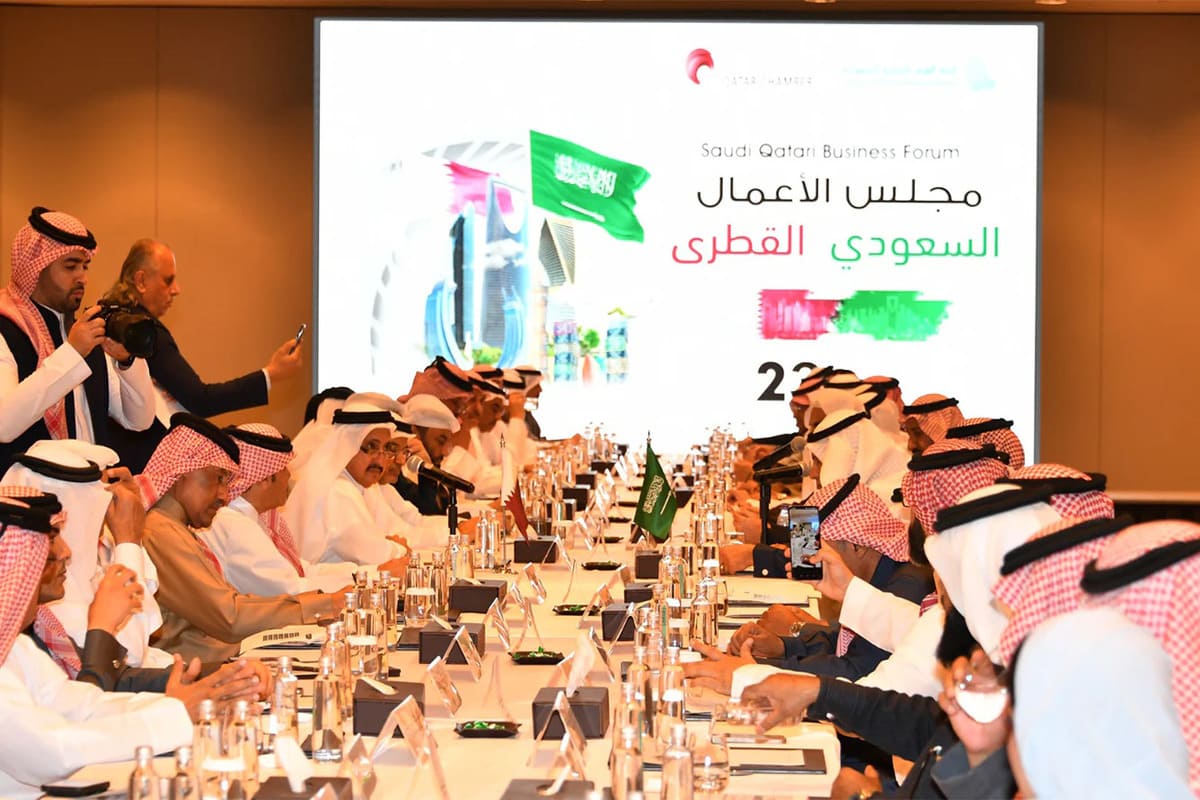 Qatar-Saudi Joint Business Council explores ways to streamline businesses. (Photo Credit: Qatar Chamber)Rail connectivity plans
Longer-term transportation projects could further support the movement of passengers, goods and services between the two countries.
In December 2025, Qatar Chamber welcomed an agreement to develop a high-speed electric rail connection between Qatar and Saudi Arabia.
The planned link would connect Doha and Riyadh through Al Hofuf and Dammam while also connecting Hamad International Airport with King Salman International Airport. Qatar Chamber said the project could improve transportation efficiency, facilitate trade flows and create opportunities for businesses in both countries.
The rail plan complements existing cooperation covering land transport, ports, customs, logistics services and supply-chain development.


